The Science
About the Science
Bioboosting Feed:
Biotin, Vitamin
and Caffeine
Boosting
Delivery system.
The hair booster
Consumer needs
Men and Women care about hair strength and growth
46% of men wish
that their
hair would be
thicker.
26% of men worry about hair loss when shampooing
their hair.
70% of men are affected
by hair loss.

Source: Women’s Haircare, 2015 (UK) und Men’s Haircare, 2017 (UK), Mintel
19% of females complain about hair thinning.
11% of females complain about a lack of hair growth and wish their hair would
grow faster.
40% of women are affected
by hair loss.
BIOTIN
An effective
combination to
boost your
hair
BIOTIN
Metabolic processes
of keratinocytes
LINOLEIC ACID
Synthesis of
ceramides 1 and 2,
involved in the
mechanical stability
of the hair
D-PANTHENOL
Hair thickness and
regeneration of
damaged hair

VITAMIN E
Decelerating keratin
and hair pigments
photooxidative
decomposition
CAFFEINE
Microcirculation and supply of nutrients to
hair and scalp

BIOTIN
Liposomally encapsulated combination of actives conducive to improved hair density and growth conditions.
Contributes to improve hair density, normalizing
the ratio of anagen and telogen
hair growth phases
Improved delivery of active ingredients
into the scalp and hair root area
Provides visible and perceptible results
Bioboosting Feed
Composition and properties

A cosmetic delivery system based on liposomes to deliver vitamins and caffeine to the hair bulbs
INCI: Water/Aqua; Alcohol; Panthenol; Lecithin; Tocopheryl Acetate; Caffeine; Biotin
Recommended usage: level 2 – 10%
Appearance: beige, viscous, fluid
Odour: ethanolic, lecithin typical
China IECIC listed
Our studies
Summary
| Ex vivo bioavailability study | In vivo hair loss prevention study & self-assessment | |
| Test area | Ex vivo skin | 12 panelists (6 female, 6 male, aged 31 – 60) |
| Test formulation | Bioboosting feed delivery system loaded with hydrophilic and lipophilic fluorescent markers vs. unencapsulated markers at equivalent concentrations. | Hair tonic formulation with 10% |
| Time of measurement | Measurements after 8 and 16 hours of penetration | Start ——-> 24 weeks |
| Test design | Determination of penetration profile of hydrophilic fluorescent marker CF (6-Carboxyfluorescin) and lipophilic fluorescent marker DiL* into the skin and hair root area using confocal laser scanning microscopy on cross-sectional cuts of skin biopsies. | Application once daily over 24 weeks. After 6, 12 and 18 weeks measurement of ratio of anagen to telogen phase hair and hair density supported by photo-documentation. Panelist self-assessment on cosmetic acceptance, efficacy and tolerance after 24 weeks. |
| Results | enhances the bioavailability of hydrophilic and lipophilic actives for hair care applications. * IUPAC name: (2Z)-2-[(E)-3-(3,3-dimethyl-1-octadecylindol-1-ium-2-yl)prop-2-enylidene]-3,3-dimethyl-1-octadecylindole; perchlorate |
Subjective scoring of good sensory results for applied hair tonic formulation. |
Bioboosting Feed…
Bioavailability
… improves the delivery of hydrophilic and
lipophilic active ingredients into the scalp and hair root area
Hair loss prevention
… contributes to improve hair density,
normalizing the ratio of anagen and telogen
hair growth phases and provides visible and perceptible results during application
Hair structure
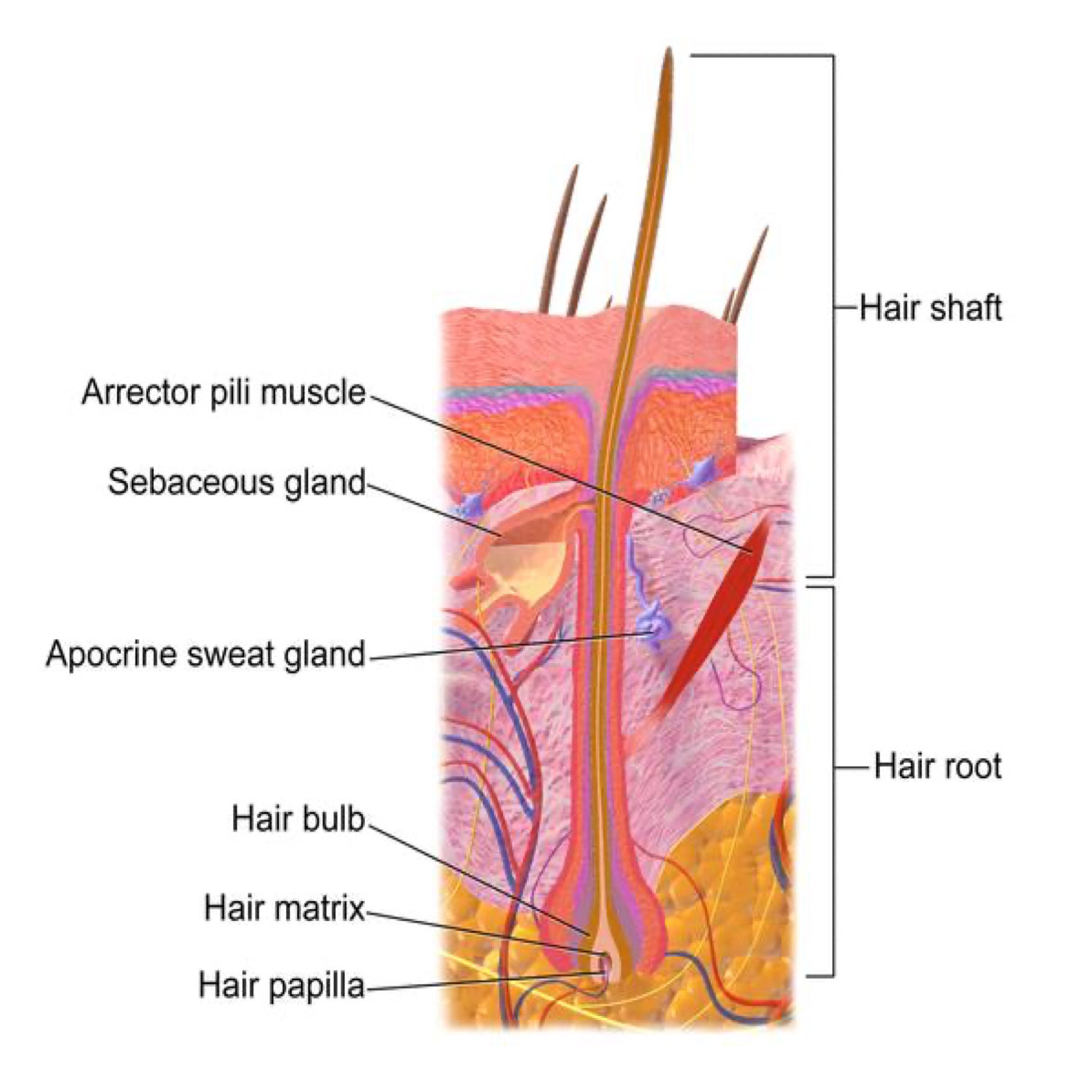
- A hair follicle is a mammalian skin organ that produces hair. Stem cells are responsible for hair production.
- The hair papilla is a large structure at the base of the hair follicle. The papilla is made up mainly of connective tissue and a capillary loop. Cell division in the papilla is either rare or non-existent.
- Hair matrix around the papilla is the hair matrix, a collection of epithelial cells often interspersed with the pigment-producing cells, the melanocytes. Cell division in the hair matrix produces the cells that form the major structures of the hair fiber and the inner root sheath.
- The hair bulb/ bulge is located in the outer root sheath at the insertion point of the arrector pili muscle. It houses several types of stem cells, which supply the entire hair follicle with new cells, and take part in healing the epidermis after a wound.
Hair Follicle Cycling
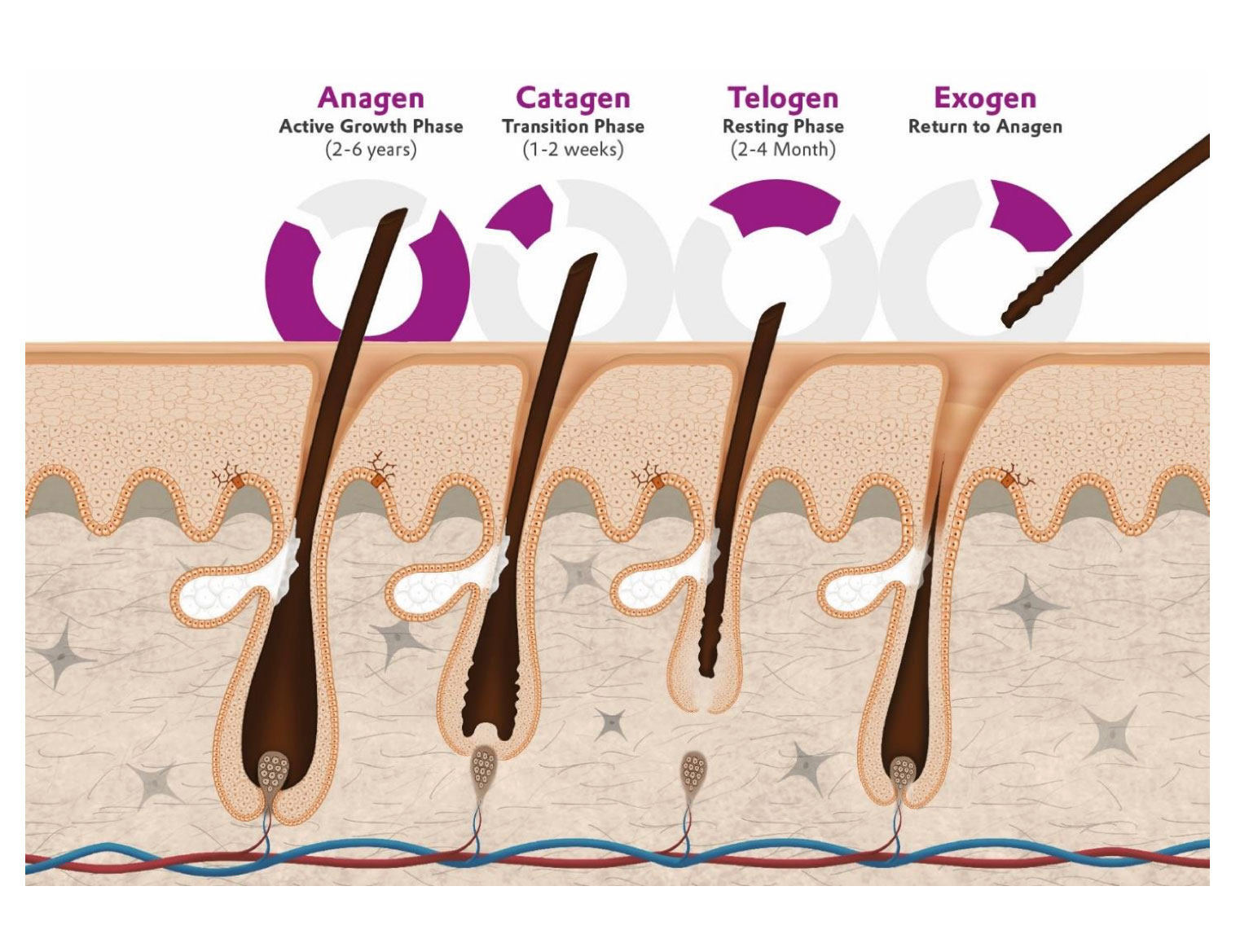
Hair grows in cycles of various phases :
- Anagen phase: active growth phase of hair follicles during which the hair root is dividing rapidly. Typical growth rate: about 1 cm every 28 days for 2– 7 years. Growth rate and remain in this stage are genetically determined. At the end of the anagen phase an unknown signal causes the follicle to go into the catagen phase.
- Catagen phase (CP): short transition stage occurring at the end of the anagen phase, signaling the end of the active growth of hair. CP lasts for
about 2–3 weeks while the hair converts to a club hair. Club hair is formed during CP when the part of the hair follicle in contact with the lower portion of the hair becomes attached to the hair shaft. This process cuts the hair off from its blood supply and from cells producing new hair. When a club hair is completely formed, the hair follicle enters the telogen phase. - Telogen phase: resting phase of hair follicle. When the body is subject to extreme stress, up to 70% of hair can prematurely enter the telogen phase and causing a noticeable loss of hair. This condition of stress is called telogen effluvium. The club hair is the final product of a hair follicle in the telogen stage, and is a dead, fully keratinized hair. 50- 100 club hair are shed daily from a normal scalp.
- Normally up to 90% of the hair follicles are in anagen phase while, 10–14% are in telogen and 1–2% in catagen. The cycle’s length varies on different parts of the body.